Beyond the Search Bar: What "Verified" Actually Means for Your NDIS Support
6/3/2026
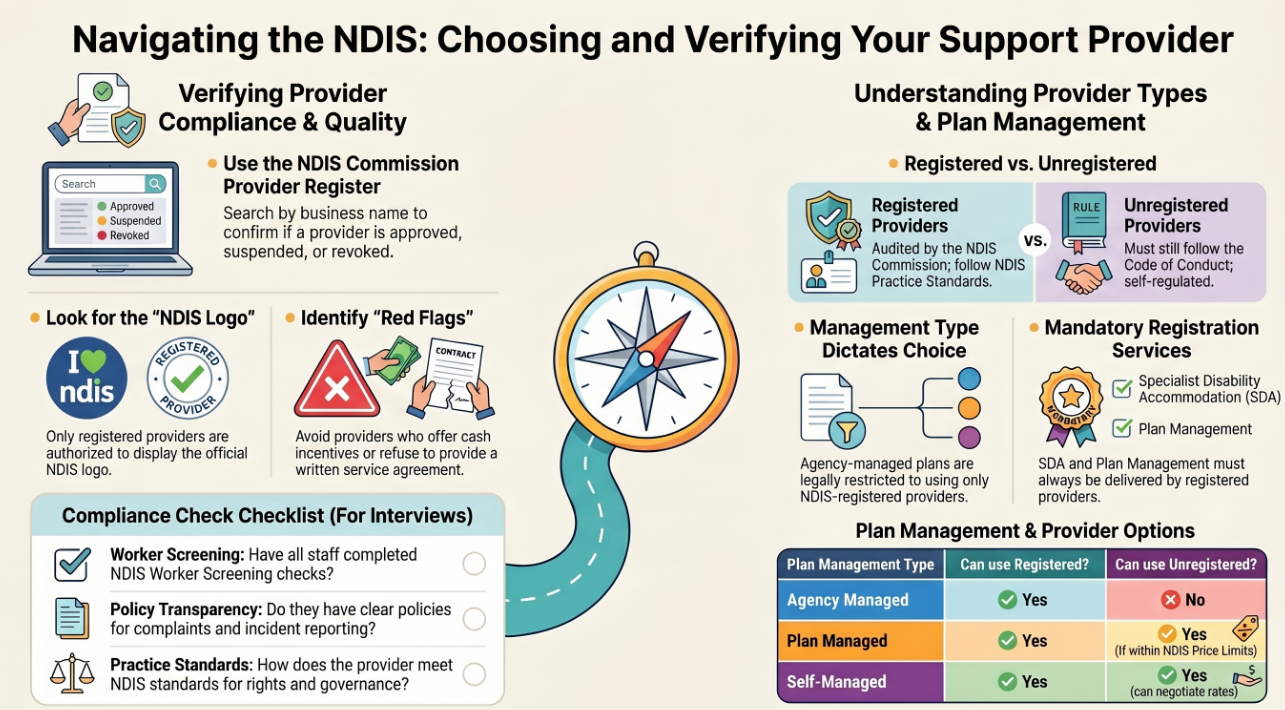
1. The Choice Paradox: You’re the Team Owner
Navigating the NDIS can feel like standing in the middle of a crowded stadium where everyone is shouting for your attention. In Greater Sydney alone, there are exactly 6,524 active providers as of May 2026. While having choices is the heart of the NDIS, it creates a "choice paradox"—the more options you have, the harder it is to feel certain you've picked the right one.
I often see families struggle with the pressure to choose quickly, especially when the median response time from a provider is now just 24 minutes. It’s easy to get swept up in the speed, but I want you to feel confident enough to slow down. Think of the NDIS Quality and Safeguards Commission as the "referee" setting the rules. However, in this game, you are the team owner. Verification is simply the tool that helps you scout the best players for your circle of support.
2. The "Regulatory Trust-Mark" of Registration
When you see a provider listed as "Registered," it’s more than just a label—it’s a regulatory trust-mark. It signifies that a business has voluntarily opened its doors to intense government scrutiny. To earn and keep this status, they must clear high-level hurdles designed to keep you safe.
To maintain this status, providers must demonstrate constant compliance with NDIS Practice Standards and the Code of Conduct. They also must ensure every single staff member has cleared mandatory worker screening.
"Registered providers in the NDIS have been formally approved by the NDIS Quality and Safeguards Commission (QSC) to deliver supports and services to NDIS participants. This is essentially a regulatory trust-mark... they must demonstrate compliance over several areas including NDIS Practice Standards, the Code of Conduct, and meeting quality audit requirements."
Think of this as your safety net. While unregistered providers are still required to follow the Code of Conduct, they don’t face the same consistent, rigorous auditing. Registration is the government’s way of saying, "We’ve checked their homework so you don’t have to."
3. The "Mandatory Three" Services You Can’t Gamble On
The NDIS is built on "choice and control," but the Commission has decided that some services are simply too high-stakes to leave to chance. Regardless of how you manage your plan, these three services must be delivered by a registered provider:
- Specialist Disability Accommodation (SDA): The physical homes built for those with very high support needs.
- Specialist Behaviour Support: Complex strategies that may involve restrictive practices.
- Plan Management: The experts who handle your funding and pay your providers.
The logic is simple: because these services involve your housing rights, your physical safety, or your entire budget, they require the most rigorous auditing. You wouldn’t want an uncertified accountant managing your life savings; the NDIS applies that same logic to your care.
4. Your Management Style is Your "Gatekeeper"
How you choose to manage your plan dictates who you can let through the door. I often describe this as the trade-off between "Choice" and "Admin."
- Agency-Managed: The NDIA manages your plan. You are restricted strictly to registered providers.
- Plan-Managed: The most popular choice for a reason. You can use both registered and unregistered providers, as long as they follow NDIS Price Guide limits.
- Self-Managed: Total flexibility. Use any provider and negotiate your own rates, but you handle all the paperwork.
My Professional Reflection: Most families I consult with land on Plan Management. It’s the "middle ground" that offers the provider freedom of self-management without the "weekend-consuming" paperwork. It pays your bills and keeps your options open, which is why it's the most popular model in the system.
5. The 6-Step Compliance "Health Check"
"Verified" can mean different things. On platforms like Carevo, a "Verified" badge often means a manual ABN and registration group cross-check has been performed by a human—a different layer of security than the government's register. Here is how to perform your own check:
- Check the Official Status: Search the NDIS Commission’s Provider Register by legal name. Specifically look to see if they are Approved, Suspended, or Banned.
- Verify the ABN: Ensure their Australian Business Number is active and matches their legal name.
- Ask for Policies: A compliant provider will readily share their incident management and privacy policies with you.
- Confirm Worker Training: Ask if their staff have completed the "Quality, Safety and You" NDIS worker orientation module.
- Audit the Registration Groups: A provider might be "Registered," but are they registered for your specific needs? (e.g., "Community Nursing" vs "Household Tasks").
- Seek Independent Feedback: Don’t just look at their website. Ask other participants or check independent review communities for honest follow-through.
6. Spotting the "Red Flags" Before Signing
Compliance isn't just about filing papers; it's about how the provider treats you. In my experience, the following signs suggest a provider is cutting corners on your safety:
- Unilateral Changes: They make changes to your support schedule or workers without talking to you first.
- Missing Paperwork: They try to start services without a written service agreement or fail to share service bookings with you.
- Pressure Tactics: Offering cash, gifts, or "sign-on bonuses" to get you to commit quickly.
- Policy Avoidance: They become vague or defensive when you ask how they handle complaints.
Remember, feeling ignored or disrespected is a valid regulatory red flag. Under the NDIS Practice Standards, your right to dignity is a requirement, not a luxury.
7. Control is the Ultimate Goal
Verification is a tool, not a trap. It is designed to help you build a circle of support that you can trust implicitly. Whether you choose a registered provider for the extra oversight or an unregistered one for a specific niche, the power remains with you.
No decision you make is permanent. You have the right to switch providers at any time if your standards aren't being met. You are the one in the driver's seat.
Is your current provider meeting the NDIS Practice Standards, or are they just checking a box?
supportsearch.com.au is a network of NDIS verified providers over 20K you can trust.