How to Choose the Right NDIS Support Worker (And What Good Answers Look Like)
6/8/2026
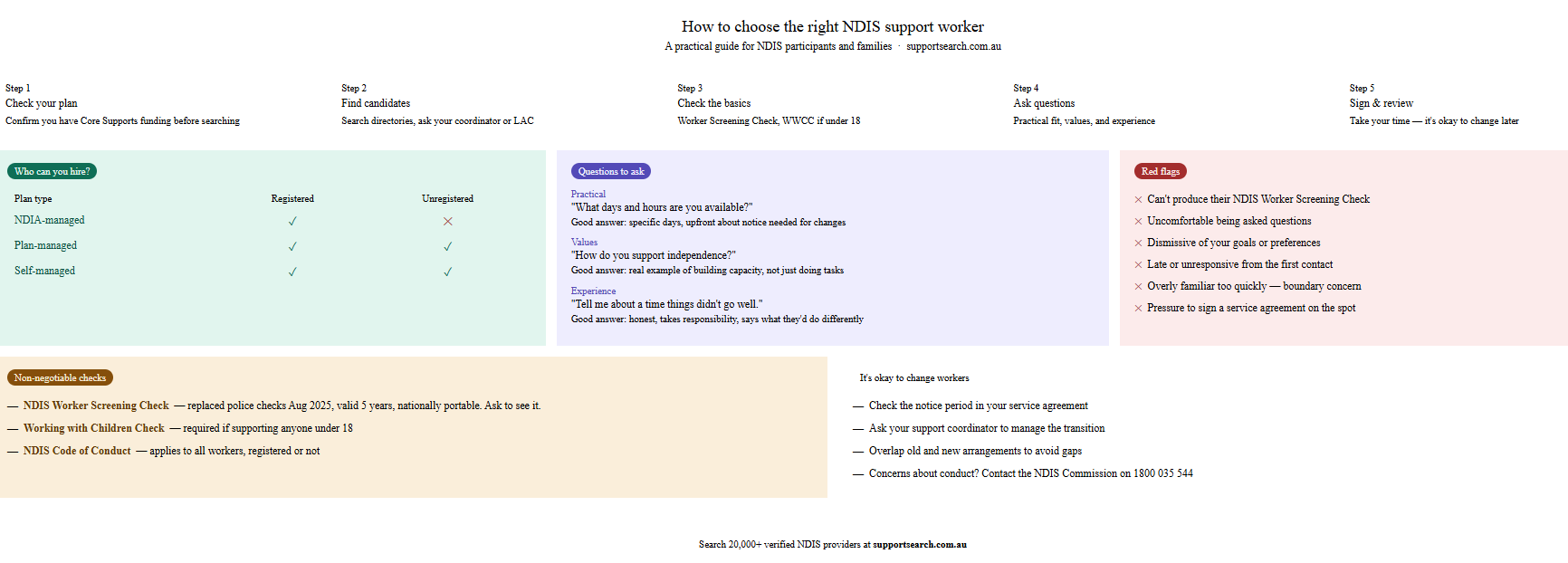
Finding an NDIS support worker isn't like picking a tradie or booking a cleaner. This is someone who may be in your home, helping with personal care, accompanying you or your family member to appointments, or spending hours every week as part of daily life. The stakes are higher — and the process deserves more care.
The good news: there's a practical way through it. This guide covers how to check your plan first, where to search, what every support worker should have on paper, the questions worth asking, and — crucially — what a good answer actually sounds like.
Check Your Plan Before You Start Searching
Before you open a search directory, spend five minutes with your NDIS plan. It'll save you a lot of frustration later.
Support workers are typically funded under Core Supports — specifically the Assistance with Daily Life or Assistance with Social, Economic and Community Participation budget lines. If you're not sure what you're funded for, your plan manager or support coordinator can walk you through it quickly.
Your plan management type also determines who you can hire:
| Plan management type | Can use registered providers? | Can use unregistered providers? |
|---|---|---|
| NDIA-managed | Yes | No |
| Plan-managed | Yes | Yes |
| Self-managed | Yes | Yes |
If your plan is NDIA-managed, you're limited to registered providers. If you're plan-managed or self-managed, your options are broader — which usually means more choice, especially in regional areas.
Registered provider: A provider who has applied to be registered with the NDIS Quality and Safeguards Commission and meets certain quality and safety requirements. Registration doesn't automatically mean "better" — it means they've met a specific compliance threshold.
Unregistered provider: A provider who isn't registered with the NDIS Commission. They're often sole traders or small local operators. They can still be excellent — but they're only available to self-managed and plan-managed participants.
Does your support coordinator or LAC help with this?
Yes — and it's worth using them. If your plan includes Support Coordination funding, your coordinator's job is partly to help you find and set up providers. That includes shortlisting support workers.
If you have a Local Area Coordinator (LAC) rather than a support coordinator, they can still answer questions about your plan and give local recommendations. They won't manage the process for you, but they're a useful starting point.
Where to Actually Find NDIS Support Workers
There are a few reliable ways to search. None of them are perfect on their own — use a combination.
Online directories are the fastest starting point. SupportSearch lists 20,000+ verified NDIS providers — registered and unregistered — searchable by suburb and service type. The NDIS Provider Finder lists registered providers only.
Other options worth trying:
- Your support coordinator or LAC — if you have one, ask them who they've seen do good work locally. They usually know.
- Disability Facebook groups and community forums — honest, first-hand recommendations from people in similar situations. Search for your state or disability type. These are often more useful than formal reviews.
- SupportSearch Community Q&A — ask a question and get answers from verified providers directly.
A note on regional and remote areas: Availability drops significantly outside major cities. If you're in a regional area, try searching the nearest large town rather than your exact suburb — you'll usually get more results. Some participants in remote areas also use support workers who travel, or combine in-person and telehealth-eligible services.
What Every NDIS Support Worker Should Have
Before you get to personality fit and experience, there are baseline checks every support worker needs to pass. These aren't optional.
NDIS Worker Screening Check
This is the main one. As of August 2025, the NDIS Worker Screening Check has fully replaced police checks as the national safety requirement for support workers. All new workers must have it; existing workers on platforms that previously accepted police checks have been required to transition.
NDIS Worker Screening Check: A national background screening assessment that looks at criminal history, workplace misconduct findings, and other relevant information to determine whether a person poses an unacceptable risk of harm to people with disability. It's valid for 5 years and recognised in every state and territory — workers don't need to reapply when changing employers.
You can ask to see a copy or verify it through your provider. If a worker can't produce one, that's a problem.
Working with Children Check
Required if the worker will be supporting anyone under 18. Requirements vary slightly by state, but it's non-negotiable when children are involved.
NDIS Code of Conduct
All NDIS workers — registered or not — are bound by the NDIS Code of Conduct. It covers things like acting with respect, maintaining privacy, providing safe support, and not using their position to exploit participants. Workers employed by registered providers are also required to complete the NDIS Worker Orientation Module before starting.
Questions to Ask — And What Good Answers Look Like
Most guides give you a list of questions and leave it there. That's not enough. You need to know what you're listening for.
These questions are grouped into three categories. You don't need to ask all of them — pick the ones that matter most for your situation.
Practical and logistical questions
"What days and hours are you available?" Good answer: They give you specific days, flag any regular commitments that might affect scheduling, and are upfront about how much notice they need for changes. Watch out for: Vague answers like "pretty flexible" without specifics. You need to know whether they can actually cover the times you need.
"How do you handle cancellations — yours and mine?" Good answer: They explain the NDIS short-notice cancellation rules clearly (within 7 days counts as short notice under the NDIS Pricing Arrangements), and they're straightforward about their own cancellation history. Watch out for: Workers who are dismissive about reliability, or who can't explain how the cancellation policy works. It matters when you're managing a budget.
"Do you drive, and do you have your own transport?" Good answer: Yes or no, stated clearly — and if they don't drive, they're honest about how that affects what they can support you with. Watch out for: Ambiguity. Transport limitations affect what support looks like in practice.
"Do you have experience working with someone with [specific disability or condition]?" Good answer: They give you a concrete answer about their experience, including what that support looked like day-to-day. If they haven't worked with that condition before, they say so and explain what relevant experience they do have. Watch out for: Generalisations ("I work with all kinds of people") that don't tell you anything.
Values and approach questions
"How do you approach supporting someone's independence?" Good answer: They understand that the goal is to build capacity and support choices — not to do things for someone because it's easier. They give you a real example. Watch out for: Workers who describe their job mostly in terms of tasks completed, without any reference to the participant's goals or preferences. Good support workers think about what you're working toward, not just what's on the list.
"What do you do when a participant wants to do something you think is risky?" Good answer: They explain how they'd have a respectful conversation, provide information, and ultimately respect the participant's right to make their own decisions. They might mention they'd document the conversation or raise it with a coordinator if there were serious safety concerns. Watch out for: Workers who say they'd just "stop" the person, or who can't articulate respect for participant choice and control.
"How do you communicate with families or carers — and how do you handle situations where the participant and the family disagree?" Good answer: They understand that the participant is the primary person they're supporting. They communicate with families in ways the participant has agreed to, and they know whose preferences come first. Watch out for: Workers who default to speaking with the family over the participant. This is a significant values issue in disability support.
Experience and qualifications questions
"What formal qualifications do you have?" Good answer: A Certificate III or IV in Individual Support (Disability), or equivalent. They might also have specific training relevant to your situation — complex behavioural support, manual handling, medication assistance, or a particular disability type. Watch out for: There's no minimum qualification requirement for NDIS support workers — anyone with a Worker Screening Check can technically work as one. If qualifications matter to you, ask specifically. Lack of formal qualifications doesn't automatically rule someone out, but it should prompt more questions about experience.
"Can you tell me about a situation that didn't go well with a participant? What happened?" Good answer: They can give you a real example, explain what went wrong, take appropriate responsibility, and tell you what they'd do differently. This shows self-awareness and honesty. Watch out for: Workers who say they've never had a difficult situation, or who blame everything on the participant or a previous employer.
Red Flags to Watch For
Most support workers are doing good work. But it's worth knowing what to watch for.
- Vague about their screening check or qualifications. If someone deflects or changes the subject when you ask to see their NDIS Worker Screening Check, don't proceed.
- Uncomfortable with being asked questions. A good support worker expects this conversation. If someone seems offended that you're interviewing them, that tells you something.
- Dismissive of your goals or preferences. If they talk over you, minimise what you've said matters to you, or make assumptions about what you need — trust that feeling.
- Unreliable from the start. Late to the first meeting, doesn't follow through on sending a service agreement, takes days to reply to basic messages. Reliability in the beginning usually reflects reliability later.
- Overly familiar too quickly. Warm and professional is good. But a worker who moves very quickly to a personal relationship, shares a lot about their own problems, or creates a sense of secrecy or special connection — those are boundary concerns worth taking seriously.
- Pressure to sign quickly. You're entitled to take your time. A service agreement isn't something you need to sign in the room.
If you ever have concerns about a support worker's conduct, the NDIS Quality and Safeguards Commission takes complaints at 1800 035 544, or via the NDIS Commission website.
It's Okay to Change Your Support Worker
This is worth saying clearly: changing support workers is normal. It doesn't mean you made a bad choice — it means you have information now that you didn't have before.
If things aren't working, you can:
- Talk to the provider directly and request a different worker
- End the service agreement (check the notice period — it's usually in the agreement itself)
- Start fresh with a different provider
Your support coordinator can help manage the transition, including overlapping old and new arrangements so there's no gap in support. If you don't have a support coordinator, your LAC can point you in the right direction.
The NDIS is built on the principle of choice and control. Choosing again — or choosing differently — is part of how that works.
Find NDIS Support Workers Near You
SupportSearch lists 20,000+ verified NDIS providers across Australia — registered and unregistered — searchable by location and service type. If you're not sure where to start, the Tools page has free resources to help you understand your plan and check rates before you sign anything.