NDIS Funding Cut? Don't Panic: How to Successfully Request a Plan Variation
6/7/2026
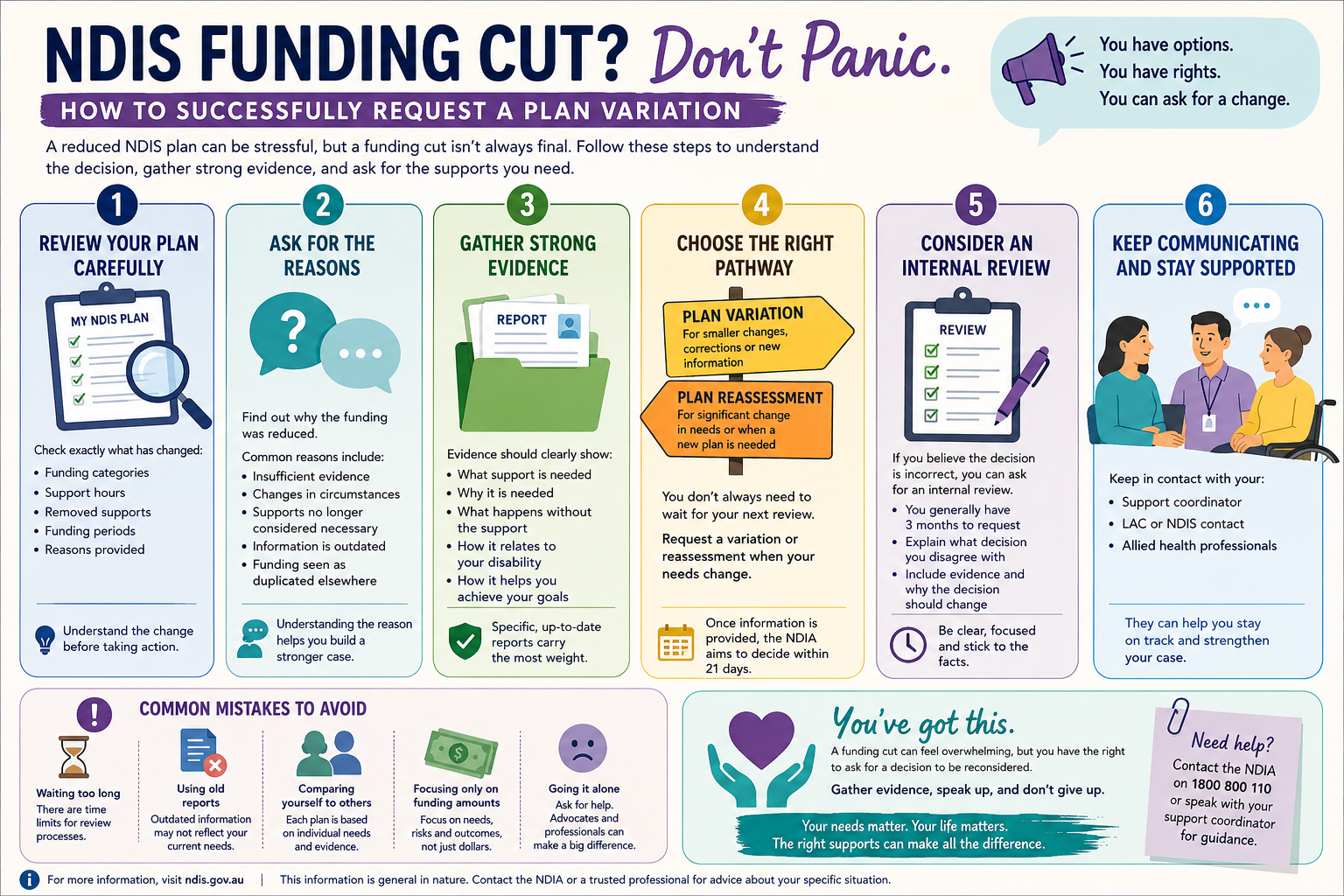
Finding out that your NDIS funding has been reduced can be a shock.
Maybe you've opened your new plan and noticed fewer support hours. Perhaps funding for therapy has been reduced. Or maybe a support that was previously funded has disappeared altogether.
For many participants and families, the first reaction is panic.
"How am I supposed to continue my supports?"
"Who do I call?"
"Can they really do this?"
If you've recently received a plan with less funding than expected, you're not alone. Many participants have reported funding reductions in recent years, particularly during plan reassessments. While every situation is different, one thing is certain: a funding cut does not automatically mean you have reached the end of the road.
There are processes available to challenge decisions, provide additional evidence, and request changes to your plan.
This guide explains what to do if NDIS cuts your funding, how plan variations work, and the practical steps you can take to give yourself the best chance of achieving a better outcome.
Step 1: Don't Panic and Don't Make Assumptions
When people see a reduced budget, they often jump straight to the worst-case scenario.
Before doing anything else, take some time to carefully review your plan.
Look at:
Which funding categories changed
Whether support hours were reduced
Whether specific supports were removed
Any changes to funding periods
The reasons provided in your planning documents
Sometimes the overall budget may appear lower, but funding has simply been allocated differently. In other cases, there may be a genuine reduction that needs to be addressed.
The key is understanding exactly what has changed before taking action.
Step 2: Request the Reasons Behind the Decision
One of the most important questions you can ask is:
"Why was this funding reduced?"
You have a much stronger chance of challenging a decision when you understand the reasoning behind it.
Common reasons for funding reductions include:
Insufficient supporting evidence
Changes in circumstances
Supports being considered no longer necessary
Reports that are outdated
Funding being viewed as duplicated elsewhere in the plan
Changes made during a reassessment process
Don't rely on assumptions. Ask for clarification from your planner, Local Area Coordinator (LAC), support coordinator, or NDIS contact.
The more information you have, the easier it becomes to build your case.
Step 3: Gather Strong Evidence
This is where many participants either win or lose their case.
The NDIS makes decisions based heavily on evidence.
Saying "I need more support" is rarely enough.
Showing why you need support is far more powerful.
Useful evidence may include:
Occupational therapy reports
Physiotherapy reports
Psychology reports
Specialist medical reports
Functional capacity assessments
Behaviour support reports
Support worker observations
Incident reports
Hospital discharge summaries
The strongest reports usually explain:
What support is needed
Why it is needed
What happens if the support is not provided
How the support relates to your disability
How the support helps you achieve your goals
For example, an occupational therapist who simply recommends support worker hours may not be as persuasive as a therapist who clearly explains the risks of falls, injury, social isolation, or loss of independence without those supports.
Specific evidence almost always carries more weight than general statements.
Step 4: Consider Whether a Plan Variation Is Appropriate
Many participants assume they must wait until their next plan review.
That is not always true.
The NDIA allows participants to request changes to their plan at any time. In some situations, a plan variation may be appropriate. A plan variation changes part of an existing plan without requiring a completely new plan.
A plan variation may be useful when:
Information has been overlooked
A correction is needed
Circumstances have changed
Additional evidence has become available
Urgent support needs have emerged
The NDIA states that participants do not need to wait for a scheduled check-in before asking for a change. Once the required information and evidence have been provided, the NDIA aims to make a decision within 21 days.
Step 5: Know When a Plan Reassessment May Be Better
Sometimes a simple variation is not enough.
If your disability support needs have significantly changed, a plan reassessment may be more appropriate.
According to the NDIA, reassessments are generally used when:
Support needs have increased
Circumstances have substantially changed
Different supports are required
A new plan may be needed to reflect current needs
During a reassessment, the NDIA looks at your entire support package rather than a small section of the plan.
This is why obtaining strong evidence beforehand is so important.
Step 6: Consider Requesting an Internal Review
If the funding reduction resulted from a formal NDIS decision and you believe the decision was incorrect, you may be able to request an internal review.
Many NDIS decisions are reviewable, including decisions relating to approved supports, plan variations, and reassessments. Participants generally have three months from receiving the decision to request a review.
When requesting an internal review, clearly explain:
What decision you disagree with
What outcome you expected
Why you believe the decision should be changed
What evidence supports your position
Avoid emotional language wherever possible.
Focus on facts.
A clear, evidence-based explanation is usually more effective than expressing frustration, even when that frustration is completely understandable.
A Simple Template You Can Use
If you're unsure where to start, the following wording can help:
"I am requesting a review of my current plan because I believe the funded supports no longer reflect my disability-related support needs.
The reduction in funding has affected my ability to access supports that assist me with daily living, community participation, and achieving my NDIS goals.
I have attached updated evidence from my treating professionals which outlines my current functional capacity, support requirements, and the risks associated with reduced support.
I respectfully request that the NDIA reconsider the funding decision based on the attached evidence."
Keep it simple.
You don't need to write a legal submission.
You simply need to explain your situation clearly and support it with evidence.
Keep Using Your Current Plan While You Wait
Many participants worry that they will lose access to support while waiting for a decision.
In many situations, your current plan continues while a reassessment is being completed. If circumstances change while an internal review is underway, you may still be able to discuss plan variations or reassessments with the NDIA.
This is why it is important to stay in contact with your support coordinator, LAC, or NDIS contact throughout the process.
Real-World Example
Imagine Sarah, a participant with multiple sclerosis.
For several years, she received funding for physiotherapy and support worker assistance.
During her latest reassessment, her physiotherapy funding was significantly reduced because the planner believed her condition was stable.
However, Sarah's neurologist and physiotherapist both documented increased fatigue, reduced mobility, and a greater risk of falls.
Rather than accepting the reduction, Sarah submitted updated reports explaining her current needs.
The reports clearly linked physiotherapy to maintaining mobility and reducing future health risks.
Following the review process, the NDIA reconsidered the evidence and increased the funding allocation.
While every case is different, Sarah's experience highlights an important lesson:
Evidence often matters more than opinions.
Common Mistakes to Avoid
If your funding has been reduced, try to avoid these common mistakes:
Waiting Too Long
There are time limits for some review processes. Acting early gives you more options.
Submitting Old Reports
A report from three years ago may not accurately reflect your current situation.
Comparing Yourself to Other Participants
The fact that someone else receives a particular support does not automatically mean it will be funded in your plan.
Focusing Only on Funding Amounts
The strongest arguments focus on disability-related needs, risks, and outcomes rather than simply requesting more money.
Going It Alone
Support coordinators, advocates, allied health professionals, and disability advocacy organisations may be able to help you prepare stronger evidence and navigate the process.
Final Thoughts
If NDIS cuts your funding, it can feel overwhelming. But a reduced plan does not necessarily mean the decision is final.
Take time to understand what changed. Gather strong evidence. Speak with the professionals who know your situation. Consider whether a plan variation, reassessment, or internal review is the most appropriate pathway.
Most importantly, don't assume that "no" is the end of the conversation.
Many successful funding changes happen because participants take the time to understand the process, provide updated evidence, and clearly explain how the funding decision affects their daily life.
The NDIS is designed to respond to people's support needs. If your plan no longer reflects those needs, there are pathways available to ask for it to be reconsidered.
The sooner you start, the better positioned you'll be to advocate for the supports you need.